
If you’re visiting Japan for the first time, you’ve probably already heard about the country’s reputation for being clean, respectful, and incredibly organized. And it’s true !
But what no one tells you is that the etiquette isn’t there to make you nervous. It’s simply part of how Japanese society makes daily life smoother for everyone. Once you understand a few basics, traveling in Japan becomes so much more enjoyable.
After multiple trips across Tokyo, Kyoto, and Osaka, here are the etiquette tips we wish we knew from Day 1.
Table of Contents
- 1: Don’t Walk and Eat — Ever
- 2: Be quiet on the trains
- 3: Shoes off means SHOES OFF!
- 4: Cash is king!
- 5: When in Doubt: Bow Slightly
- 6: Don’t Tip — Say “Arigatou” Instead
- 7: Be Mindful with Chopsticks!
- 8: Queuing Is a Big Deal
- 9: Trash Bins Are Rare — Carry Your Garbage
- 10: Spatial Awareness
- 11: . Say “Sumimasen” Often — It’s a Magic Word
1: Don’t Walk and Eat — Ever
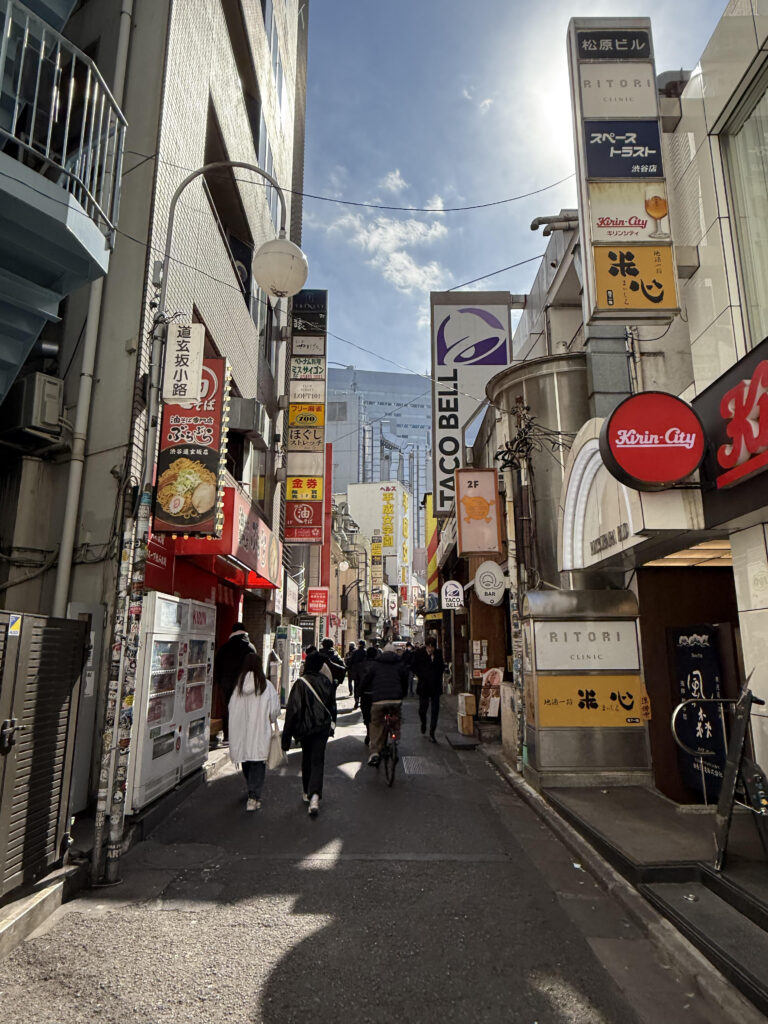
Japan is clean for a reason: people don’t wander around with food in their hands.
What to do:
- Finish food where you bought it
- Use designated eating areas
- Keep trash with you until you find a bin (they’re rare!, train stations will have some)
2: Be quiet on the trains
If you are from North America like us, people will talk loudly on the trains, talk on the phone. However, in Japan, it is quiet – really quiet. No one talks on their phone, or really talks at all on the train. It is actually really nice. If you need to know how to use a train, read our blog!
What to do:
- No phone calls
- Keep conversations low
- Switch your phone to silent (“manner mode”)
3: Shoes off means SHOES OFF!
Anytime you see slippers, a raised platform or tatami, remove your shoes.
Common places you’ll remove shoes:
- Traditional restaurants
- Temples and shrines
- Ryokan (traditional inns)
- Changing rooms in clothing stores
- Some Airbnb-style accommodations
4: Cash is king!
Japan is modern and card is accepted mostly everywhere. However, if you are looking for small ramen shops, gift stores etc., they will only accept cash.
Etiquette tips:
- Place your money in the tray at checkout (never hand it directly)
- Accept change with two hands
- Don’t count coins slowly, step aside if needed
5: When in Doubt: Bow Slightly
We bowed all of the time in Japan as a sign of respect. Again, theres a lot of forgiveness for tourists, they don’t expect tourists to bow perfectly, but a small bow can go a long way.
When to bow:
- Greeting someone
- Saying thank you
- Apologizing (e.g., you bumped someone on accident)
6: Don’t Tip — Say “Arigatou” Instead
Probably the most known thing. Yes, there is no tipping culture in Japan. Leaving money on the table or offering a tip is confusing, and sometimes uncomfortable for them.
Just say:
- Arigatou gozaimasu (Thank you very much) – (We said this a million times a day!)
- Or simply bow as you leave
7: Be Mindful with Chopsticks!
Chopstick etiquette is simple, and important.
Do NOT:
- Stick chopsticks straight up in rice (funeral tradition)
- Pass food from chopstick to chopstick
- Point at people or dishes
- spear food
DO:
- Rest chopsticks on the holder
- Use the opposite end to grab shared dishes
8: Queuing Is a Big Deal
Japanese culture loves lines and you will find out fast how much so. People will queue for trains, food, and even photo spots.
Rule:
- Stand in line and follow the rules. Cutting in line is a major etiquette fail
9: Trash Bins Are Rare — Carry Your Garbage
As we mentioned above, trash bins are rare.
Etiquette Tip
- Carry out all of your garbage back to your accommodation or find a trash bin (7-Eleven will have some inside)
10: Spatial Awareness
People walk fast, and in certain directions. There is no time to stop and stare at your phone.
Etiquette Tip
- If you have to look at your phone for directions, move over to the side and out of the way.
Check out our Google Maps blog!
11: . Say “Sumimasen” Often — It’s a Magic Word
The most useful word in Japan
It means
- Excuse me
- Sorry
- Thank you